
A client in Combe Down called us last month with a problem we see time and again: the heating was working fine, radiators warm right through the house, but not a drop of hot water from any tap. If your boiler has heating working but no hot water, you’re not alone, and in most cases it’s fixable without needing a full replacement. Our domestic boiler servicing and repairs team covers Combe Down and the rest of Bath, and this fault is one of the most common callouts we get. Here are the five causes we find most often, and what to check yourself before booking an engineer.
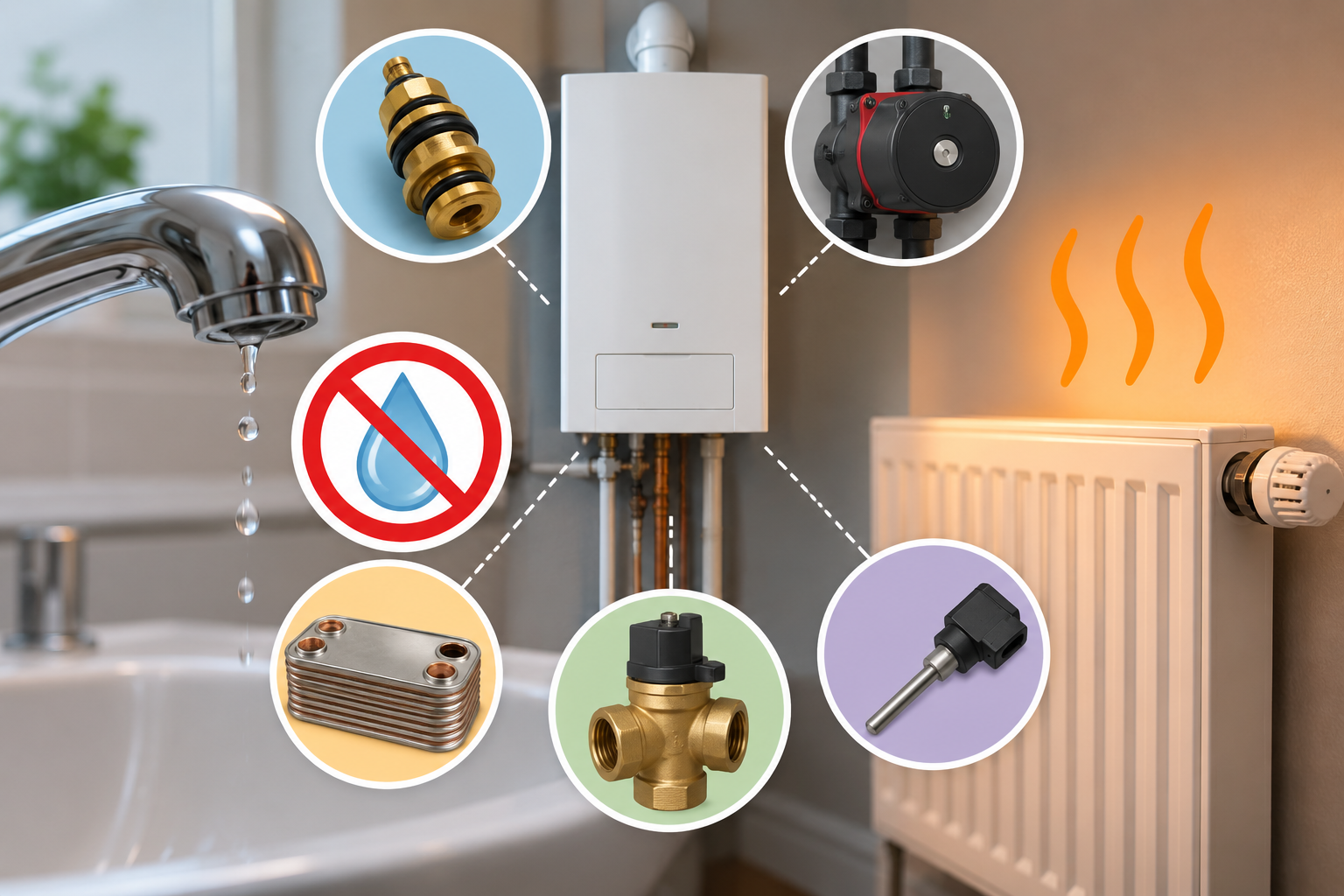
Why Heating Can Work While Hot Water Doesn’t
Most combi boilers use a single heat source to run two separate jobs: heating your radiators and heating water on demand for your taps. Because these two functions run through different parts of the boiler, it’s entirely possible for one to fail while the other keeps working normally. System and regular boilers, which store hot water in a separate cylinder, have their own extra parts that can fail independently too.
5 Reasons Your Boiler Has Heating But No Hot Water
1. A Stuck or Faulty Diverter Valve
In a combi boiler, the diverter valve decides whether water is sent to your radiators or to your hot taps. It’s a hard-working part, and over time it can wear, stick, or fail to move fully into the hot water position. When that happens, your heating carries on as normal while the taps run cold. This is a common repair and usually just means replacing the valve.
2. Limescale Building Up in the Plate Heat Exchanger
Bath and the surrounding villages, including Combe Down, sit in a notably hard water area. Over time, limescale can build up inside the plate heat exchanger that heats water for your taps, restricting or blocking flow. The central heating circuit is often a sealed system that isn’t affected in the same way, which is why heating keeps working while hot water doesn’t. A professional descale or heat exchanger replacement usually resolves it.
3. A Faulty Thermostat, Timer or Programmer Setting
Sometimes the answer is simpler than a mechanical fault. If your hot water schedule has been switched off, altered, or the programmer has developed a fault, the boiler may never call for hot water even though the heating circuit runs on its own separate schedule. This is one you can safely check yourself: look at your programmer or smart thermostat and confirm the hot water setting is switched on and timed correctly.
4. An Airlock in the Hot Water Pipework
Trapped air in the pipework feeding your hot taps can block water flow without affecting your radiators at all. This is different from air in a radiator, which you can bleed yourself. An airlock in the hot water system typically needs an engineer to clear it safely, particularly if it’s near the boiler itself.
5. A Stuck Motorised Valve or Faulty Cylinder Thermostat (System and Regular Boilers)
If your home has a hot water cylinder rather than a combi boiler, a stuck motorised valve or a failed cylinder thermostat can stop water in the cylinder from heating, even though the central heating side is calling for heat and working normally. These parts sit outside the boiler itself, which is another reason the two systems can behave independently.
Why This Is Especially Common in Combe Down and the Wider Bath Area
Combe Down and much of the Bath area have significantly hard water, which makes limescale-related faults, like the plate heat exchanger issue above, more common here than in softer water regions. A number of properties in the area are also older, with pipework and hot water systems that have been added to or adapted over the years, which can make airlocks and ageing valves more likely to cause problems.
What You Can Safely Check Before Calling an Engineer
A few quick checks can save you a wasted callout, or at least help your engineer diagnose the fault faster:
- Confirm the hot water setting on your programmer or thermostat is switched on and correctly timed.
- Check whether the problem affects every tap or just one, a single cold tap can point to a blocked tap or fitting rather than the boiler.
- Note down any fault code showing on the boiler’s display.
- Check for any obvious leaks or damp patches around the boiler or cylinder.
Beyond these checks, stop there. Never attempt to open the boiler casing or inspect internal components yourself, this kind of work should always be left to a Gas Safe registered engineer.
Is It Safe to Have Heating But No Hot Water?
Having heating but no hot water isn’t usually a safety emergency on its own, but it’s a sign something needs attention before it potentially gets worse or affects the heating circuit too. If you ever smell gas or your carbon monoxide alarm sounds, leave the property immediately, call the National Gas Emergency Service, and don’t use the boiler again until a Gas Safe registered engineer has checked it.
If your boiler in Combe Down has heating working but no hot water, our domestic boiler servicing and repairs team can diagnose the fault and get it fixed properly. You can also read more in our guide to domestic gas boiler servicing in Bath, or book an appointment directly with our team.