
A customer in Corston called us recently about a radiator that wouldn’t heat up fully, warm at the top but stone cold at the bottom, no matter how long the heating had been on. Cold spots on a radiator, whether at the bottom, in patches, or across the whole thing, are one of the most common heating faults we see. The good news is that most causes are straightforward to diagnose. Our domestic boiler servicing and repairs team covers Corston and the wider Bath area, and below are the four most common reasons a radiator ends up cold at the bottom or won’t heat up fully, along with what you can safely check yourself.
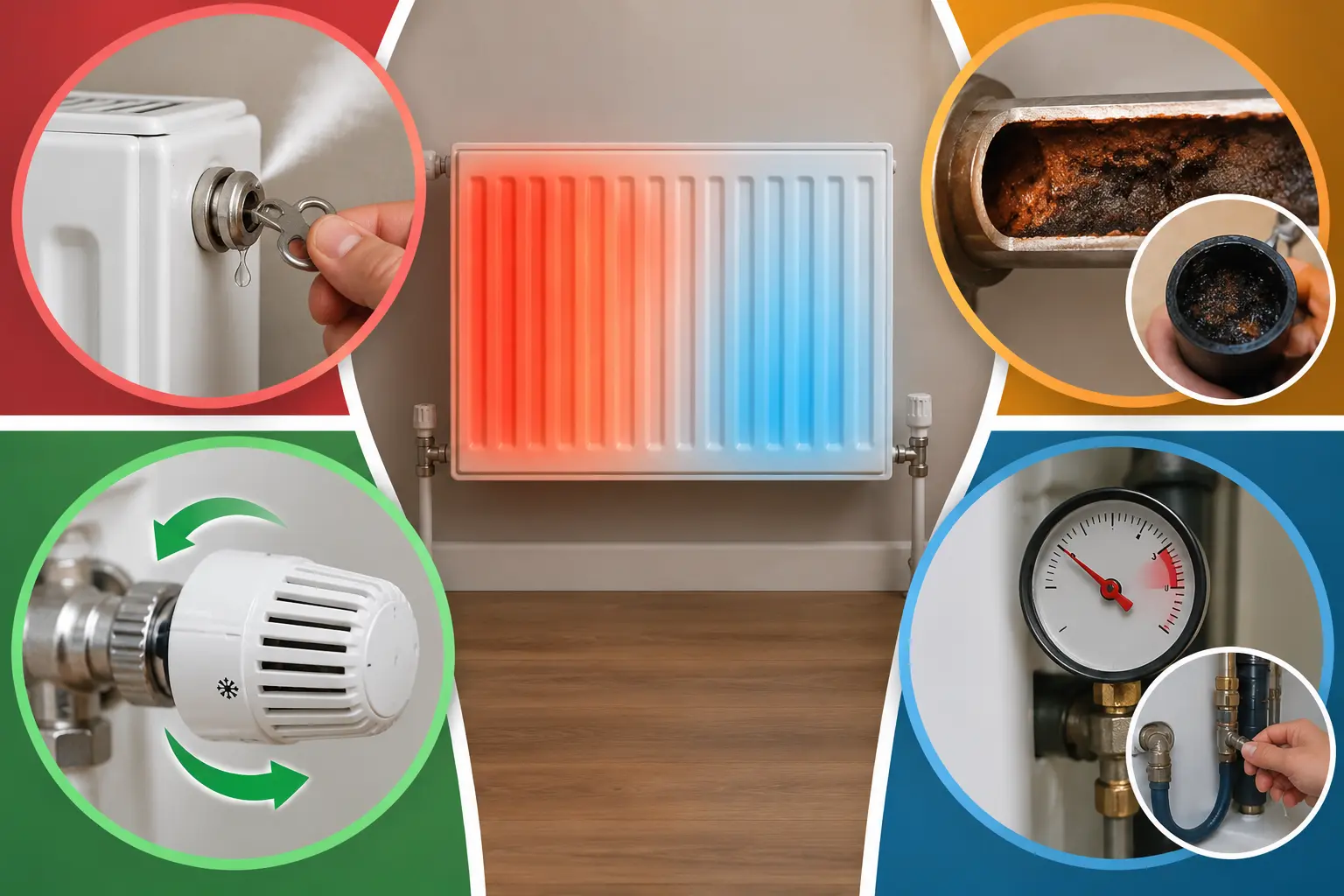
4 Reasons Your Radiator Has Cold Spots
1. Trapped Air in the Radiator
This is the classic cause of a radiator that’s cold at the top but warm underneath. Air rises and collects at the highest point inside the radiator, stopping hot water from filling that space, so the top stays cold while the bottom heats normally. It’s one of the easiest faults to fix yourself: turn off your heating, use a radiator key to slowly open the bleed valve at the top corner until water (not air) starts to trickle out, then close it again. Keep a cloth handy and check your boiler pressure afterwards, as bleeding radiators can lower it slightly.
2. Sludge or Debris Settled at the Bottom of the Radiator
If the cold spot is at the bottom rather than the top, the cause is usually the opposite problem: sludge, rust and debris that has settled at the base of the radiator over time, blocking water flow through that section. This is especially common in Corston and the wider Bath area, where hard water and older heating systems both contribute to a faster build-up inside radiators and pipework. Bleeding won’t fix this one, the radiator typically needs a power flush to clear the debris and restore full circulation.
3. A Closed or Faulty Valve
Every radiator has two valves, a manual or thermostatic valve (TRV) at one end and a lockshield valve at the other, and either one can cause a radiator to stay cold or only partially heat up if it’s closed, stuck, or has failed. Check that the TRV isn’t turned down to zero and that the valve moves freely. If the radiator is still cold with both valves open, the valve itself may need repairing or replacing.
4. Poor System Balancing Across Multiple Radiators
Sometimes a radiator isn’t faulty at all, it’s simply not getting its fair share of hot water because the heating system as a whole isn’t balanced correctly. This is more likely if you’ve had radiators added, removed, or replaced in the past, or if only distant radiators from the boiler are affected. Rebalancing a heating system properly needs an engineer, as it involves adjusting flow through every radiator, not just the one causing problems.
Why This Shows Up More in Corston and the Surrounding Villages
Corston and much of the Bath area sit in a hard water region, which speeds up the build-up of scale and debris inside radiators and pipework over time. Homes with older heating systems, or systems that haven’t been power flushed in several years, tend to see cold spots and uneven heating more often as a result.
What You Can Safely Check Yourself
A few checks can tell you a lot before you need to call anyone out:
- Feel the radiator from top to bottom to work out exactly where the cold spot is, this points to whether it’s air (cold at top) or sludge (cold at bottom).
- Bleed the radiator using a radiator key if the top is cold, following the steps above.
- Check that both the TRV and lockshield valve are open and turning freely.
- Check your boiler’s pressure gauge is within the normal range shown on the display or manual.
If bleeding doesn’t help, or the cold spot is at the bottom, stop there rather than attempting to flush or dismantle anything yourself, this is a job for a Gas Safe registered engineer.
Why Does My Radiator Have Cold Spots But Others Are Fine?
If only one or two radiators are affected while the rest of the house heats up normally, it usually points to a local issue with that radiator, trapped air, settled sludge, or a stuck valve, rather than a fault with the boiler itself. If several radiators are affected unevenly, the heating system may need rebalancing by an engineer.
If your radiator in Corston still has cold spots after bleeding it, or the cold patch is at the bottom, our domestic boiler servicing and repairs team can diagnose and fix it. You can also read more in our guide on why your boiler might be losing pressure, or book an appointment directly with our team.